Live Clay
Ceramics & Custom Urns by Laura Bruzzese
Taos, Arroyo Seco & the Search for Rebecca James
 Last Thursday, I traveled to the villages of Taos and Arroyo Seco with a friend visiting from England who was up for a little northern New Mexico adventure. (He was also slightly dessicated, as it happens, for the assimilation into the arid Southwest climate from moist & mild Sheffield proved a slow one.) The original inspiration for the journey was to visit the Harwood Museum where a rare show of reverse oil on glass paintings by Rebecca James, one of my favorite Taos Moderns who lived and worked in New Mexico in the 1930s-40s, was on display. But let’s face it, there’s never a bad time to visit Taos and Rodger’s company made it all the better: a fun traveler, a great friend, and someone who likes good coffee as much as I do.
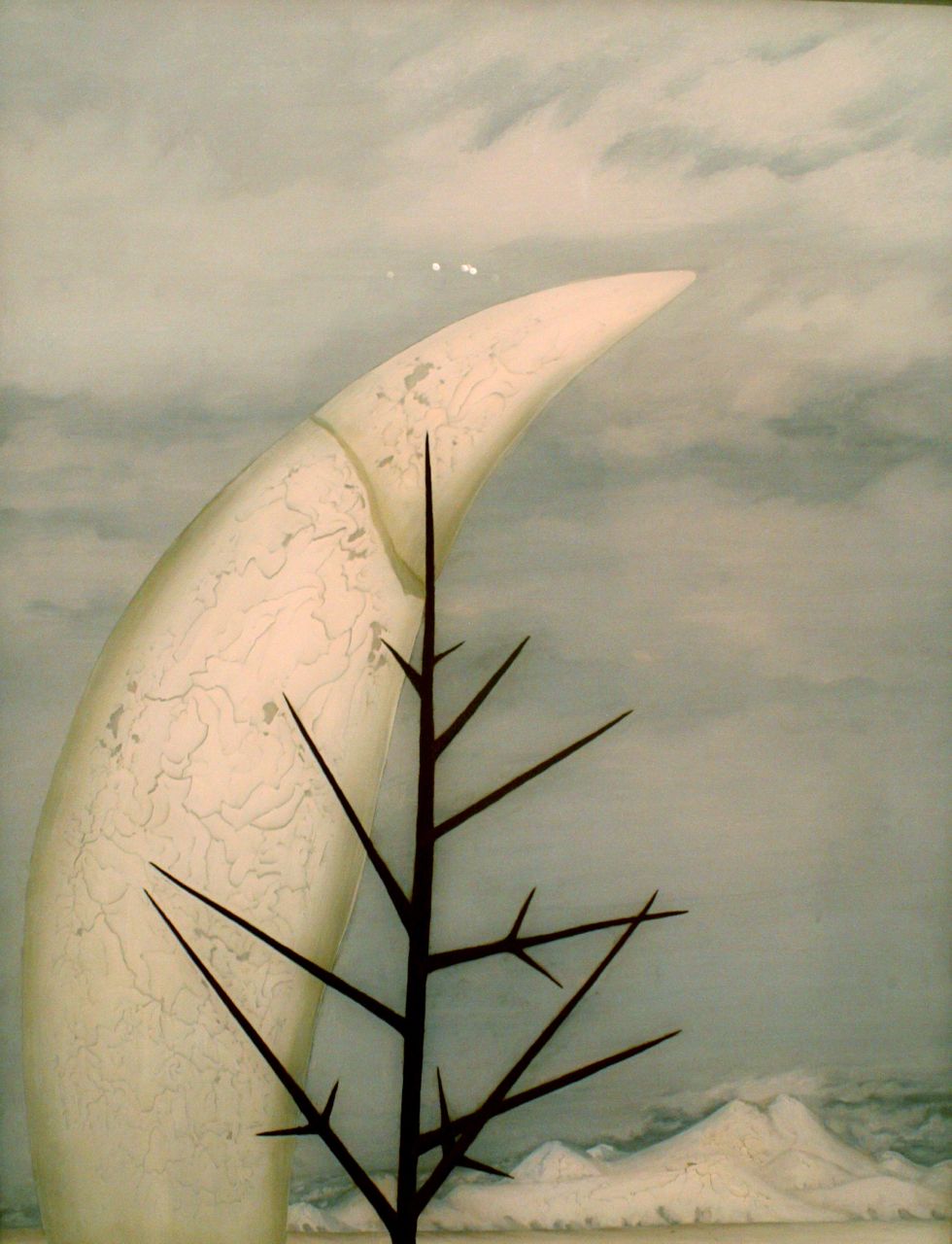
I saw my first Rebecca James paintings in the 1990s while working at a Santa Fe art gallery and was totally captivated. Since then, I’ve been on the hunt for more of her work. Sure, I’ve looked at pictures in books, but photos simply can’t capture the sensitivity and presence of the flowers, shells and New Mexico scenes she painted “backwards” with oils on glass. It’s only in the close, intimate viewing of Rebecca James’ paintings that the subtle rendering of a white shell against a white background, the translucent edge of a rose petal, the scratched-in details of a landscape, begin to reveal the inner abstract feelings — humility, simplicity, solitude, and faith — that she desired to communicate.

The reverse oil on glass painting technique originated in Italy in the 14th and 15th centuries, then spread throughout Europe, Africa, and the Middle East according to the availability and expense of glass and glass making chemicals and supplies (like wood, which was needed to heat the silica carbide). Reverse glass paintings recorded both religious and historical imagery. The technique, which involves constructing a painting in reverse (i.e., highlights that would be painted last are painted first, and words are painted backwards so they will read correctly when viewed from the front) was favored because glass provided a surface for the painting as well as protecting it after it was finished. Despite its long history, reverse glass paintings are not common among 20th century artworks, which might be what first drew me to James’ masterful use of the art form.
So on Friday I found Rebecca, thanks to this fantastic show, which also included some of her charcoal drawings and colchas (embroideries). The show closes on June 4, so anyone within 500 miles of Taos should really consider making the drive. It’s worth it. Here’s a little tribute to one of my favorite painters who, along with the other Taos Moderns and Santa Fe Colony artists, was a pioneer in delivering images of the exotic landscape, architecture, Native people, and Hispanic culture of the newly-American southwest to the rest of the world through their art. (I’ll post a few words and pictures about Taos & Arroyo Seco separately in the next few days.)
Rebecca Salsbury James and her twin sister Rachel were born backstage of the wildly successful Buffalo Bill’s Wild West Show, which their father managed, in England, 1893. After her father’s untimely death in 1902, she and her siblings moved with their mother back to Manhattan, where Rebecca felt bored, uninspired, and stifled. In 1922, she married photographer Paul Strand, a protégé of art dealer Alfried Stieglitz, and soon became part of the Stieglitz circle of avant-garde artists and writers. After contemplating taking up writing or photography, she finally decided to teach herself to paint, although she struggled and never felt satisfied with her work. In 1929, she eagerly accepted an invitation to spend the summer in Taos with her good friend, mentor, and perhaps lover, Georgia O’Keeffe, hoping to perfect the reverse oil on glass technique that fascinated her. Upon leaving the urban East and entering the vast American West, she felt liberated and energized.
For the next three years, she and Strand summered in Taos, but their marriage had fallen apart and they divorced in 1932. “Becky” James moved to Taos permanently that year and became a dramatically changed woman: she ditched the demure Victorian garb in favor of western gear, drank hard liquor, smoked cigarettes, and cussed like a man. She married banker Bill James in 1937.

In 1940 she discovered the archaic Spanish Colonial colcha embroidery technique, and devoted herself to the stitch that expressed some of the same feelings as her paintings. Becky and Bill James were active members of the Taos art and social community for the next two decades, until Bill died suddenly of a heart attack in the late 1950s. Thereafter, Rebecca suffered a long bout of rheumatoid arthritis which eventually crippled her to the point that she could no longer find solace in creating her art. In 1968, she gave away all of her possessions, wrote letters to her friends, and committed suicide with sleeping pills.
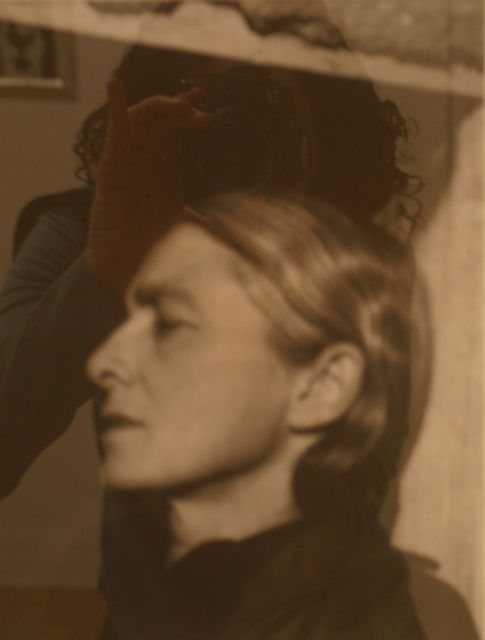 In her own words (from the exhibition catalogue): “A walking woman, a waiting woman, a watching woman, a mourning woman, a devout woman, adobe, cedar posts, old dry wood, the fields of alfalfa, the churches — I love these things. They have made me paint and I am grateful.”
Just when I thought she’d left me for another…..
Mavis is back!

Mavis is the largest Woodhouse’s Toads I’ve ever seen. She’s one of several that call our pond Home, having appeared from I don’t know where soon after I built it. I’d heard rumors that Mavis had been burrowing in someone else’s yard, but chose not to believe it. Why would she? It’s not like any of my neighbors have the variety of terrain and insects found in my yard, let alone a pond! “I think your toad has a new home under our playhouse…” Yeah, right, I thought. But when Mavis failed to appear in the pond night after night, I finally reconciled with the fact that perhaps she had found another environment that met her needs better than mine (hard to believe). But this morning… guess who was back?! Ah, yes, the grass always seems greener. But not this time.
The Woodhouse’s Toad is native to New Mexico and many other parts of the South and Southwestern US. The official description says they average 4″ in length which clearly puts Mavis in a class of her own. Each Spring, we adjust once again to what sounds like old ladies screaming in the back yard: The Woodhouse’s Toad mating call. Soon after, stringy layers of eggs can be seen in the pond and they hatch within about a week. Zillions of tadpoles then appear and they spend their formative months cleaning the pond of algae. Those who survive the pump and various other pond hazards (namely, the bullfrog), develop into tiny toads that can fit on a penny. For some reason, those zillions of tadpoles usually only result in one or two toads per season, which makes me think the prey/predator relationship in our yard must be out of balance.
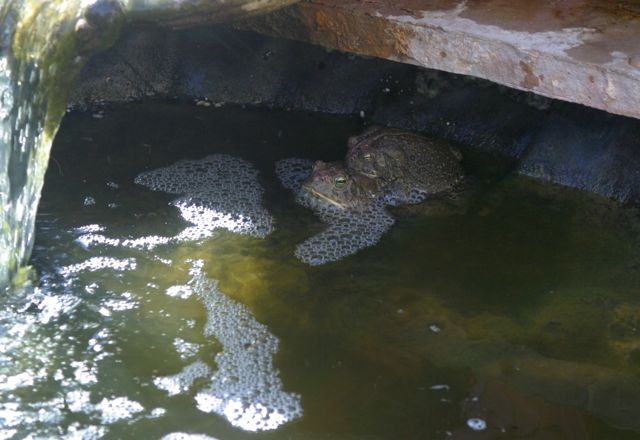
A veritable orgy each spring.
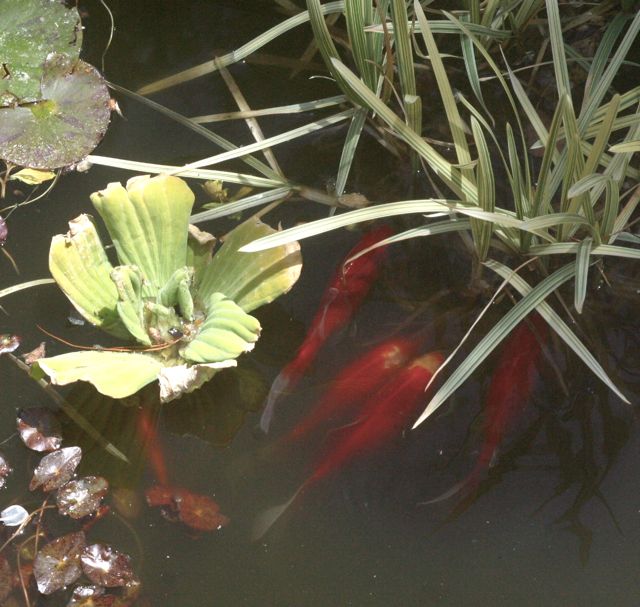
Woodhouse’s Toads live on land and in water, although they have lungs so they can’t stay in water all the time. Our toads’ hunting territory extends to the neighbors’ yards to the north and south, as well as across the street. They also like to hunt in my studio when I leave the door open. I’m kind of amazed by the fact that they can make their way under the gate, out of our yard, hop all the way down the block, then come back.
[note: another blog post was automatically generated at the end of this one, and it’s really worth the read. It’s Some Thoughts On The Common Toad, about toads and Spring in England, written by George Orwell in 1946.]
It was a strange day of wildlife at the Live Clay residence. I also found this beautiful finch on my porch

and this box turtle was cruising down the sidewalk.
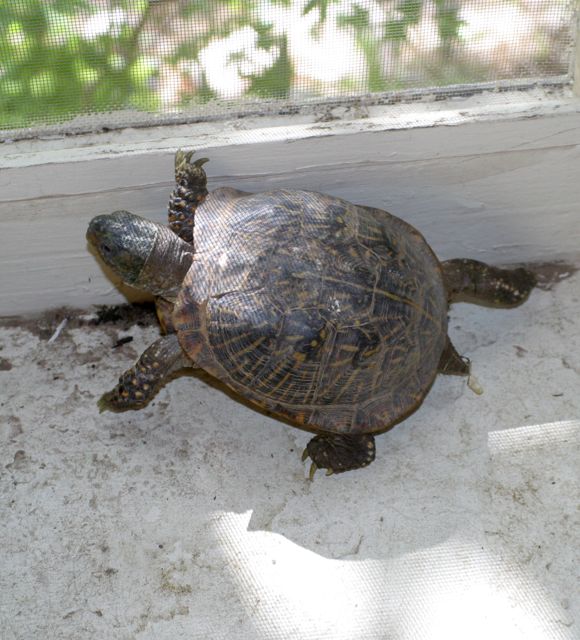
My friend picked it up and I later placed it with the Romano family where it will hopefully live a long and satisfying life.
Madrid, New Mexico & Kiln Opening [part 2]
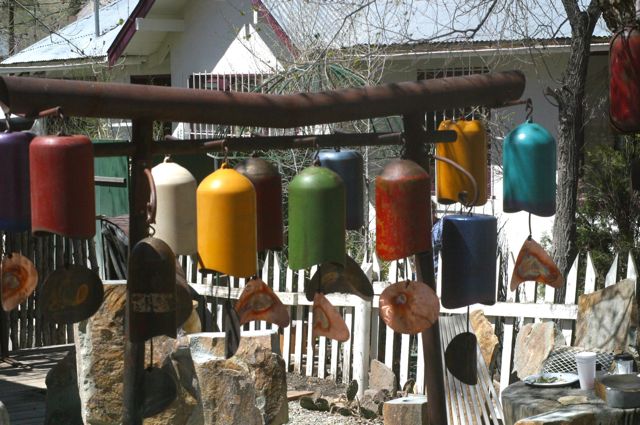
These beautiful wind gongs by Bill Lloyd, made of recycled oxygen tanks, can be found at the Range West Stone Gallery in Madrid.
This will be the final post about the anagama wood firing I participated in over the past month. I’ve been asked a few questions about Madrid, New Mexico, so I thought I’d say a little about that, then conclude with a slide show of the gorgeous skies and people of the firing, a few pictures of Madrid, and a few of my pieces that sold at the kiln opening. Similar works are being listed this week in my Etsy store.
Madrid (pronounced ma-drid in these parts), New Mexico, is located in a valley of the Ortiz mountains, and is the oldest coal mining town region in New Mexico (as early as 1850). By 1892, the village was connected by a narrow gauge spur to the Santa Fe Railroad. By 1893 a seven story anthracite breaker was constructed, and by 1899 all coal production in the area was consolidated at Coal Gulch, which later became Madrid. Wood framed cabins were dismantled in Kansas and brought to Madrid by train to house the miners and their families. The town flourished as a “Company Town” of some 2500 people. In 1919, Oscar Joseph Huber was hired as full time superintendent of mines. Under his leadership, Madrid became a model for other mining towns to follow. Schools, a fully equipped hospital, a Company Store and an Employees Club were some of the benefits of life in Madrid during the 20’s and 30’s. However, production dwindled with W.W.II and the mines closed in the 1950’s.
In the early 1970’s Joe Huber (Oscar’s son), then owner of the entire town site, rented a few of the miner’s cabins to rugged individuals, artists and craftsmen eager to make a home in the mountains of New Mexico. He remained dedicated to the town he’d grown up in and its new community until his death in the late 1980’s. Madrid is now an active village with a quiet residential area and a short but bustling “Main Street” (State Hwy 14, also known as the Turquoise Trail or the scenic route between Albuquerque and Santa Fe) with galleries, shops and a few restaurants. It has a funky vibe, thanks to the conglomeration of hippies, tourists, locals, bikers, dogs, and artists who share in daily life.
I hope my vast readership have enjoyed this little foray into my adventures along the Turquoise Trail, through Madrid, and at the anagama kiln climbing a hill in the Ortiz Mountains.
Madrid Wood Fire Kiln Opening (Day 8)
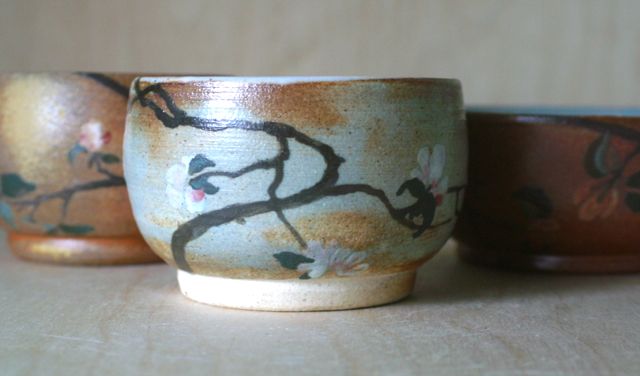
These blossom cups are a new shape and design. There are some pre-firing pictures of them in an earlier post.
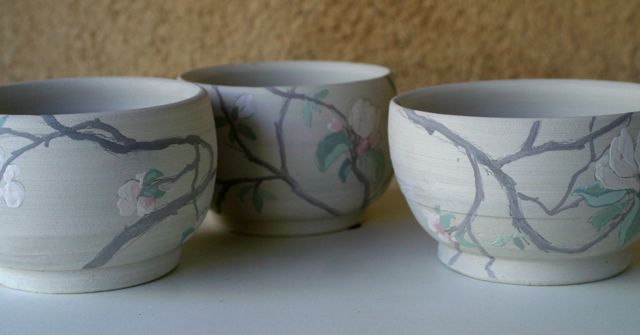
Here’s what the cups looked like before the fire got ahold of them.
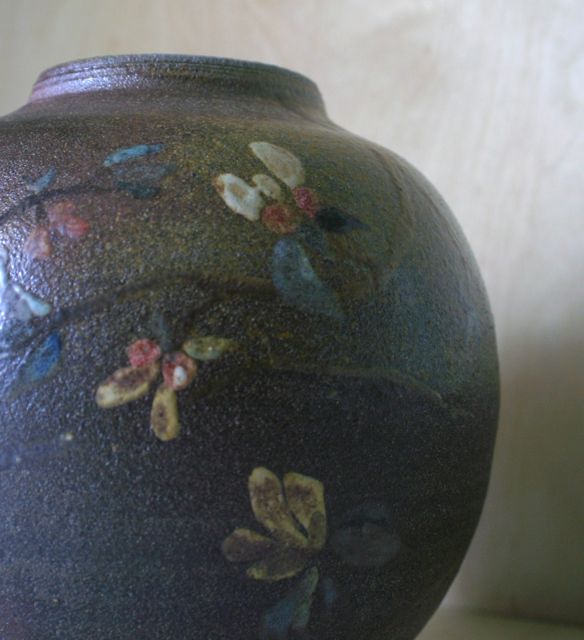
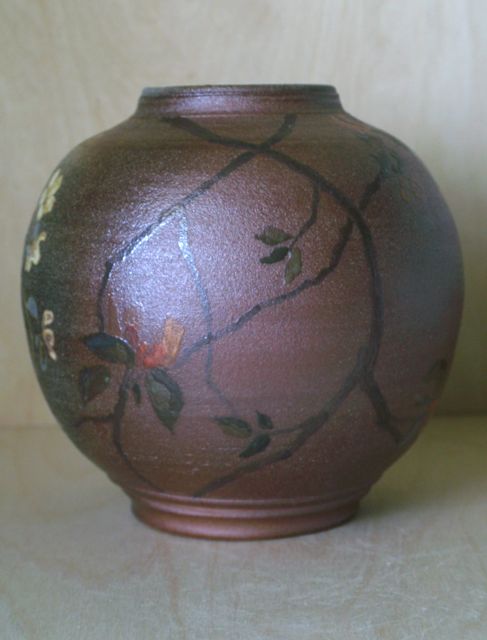
This large branchy vase is one of my favorite pieces from the firing. I ran out of time to paint it before we started loading the kiln, so I painted it green (dried but not bisque fired and very fragile!) during the hour commute to the kiln (I wasn’t driving). I love the ash effects and how they + fire changed the flowers in a way I couldn’t have.
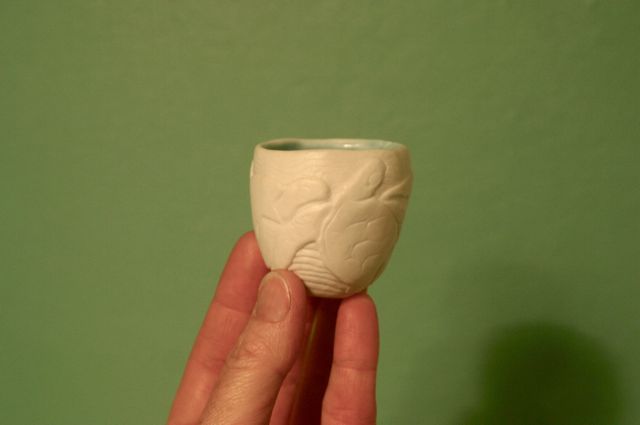
One of the best things about collaborative projects — trades! Check out this tiny little carved turtle cup by Sandria, now part of my collection.
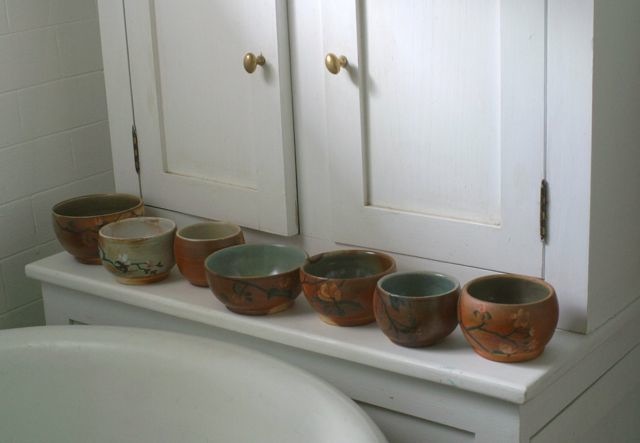
Here are the rest of the blossom bowls, lined up waiting to be photographed in my super-deluxe photography area (the bathroom). I’ll be listing these in my Etsy shop within the next few days.
Anagama: Madrid wood fire days 6-7
I got home after 1 a.m. having completed my second 6-hr shift. The kiln reached temperature (cone 11-12 in most areas, about 2300 F) throughout most of the chambers and so, for the first time ever, we ended the firing on Saturday night instead of Sunday. Here is a slide show of last night’s events. (Some of the pictures are low-light blurry because my firing mates just wouldn’t sit still but I included them anyway.) And if these aren’t enough, click here to check out the live-action video that Jesse compiled from the day before… informative and entertaining!
What the pictures don’t capture, besides the incredible thigh- and face-burning heat coming off the kiln, is the relationships: between ourselves and the fire, the kiln, one another. There’s something really special about a group of people coming together for a common purpose around a fire, as people have done for thousands of years whether for food, protection, comfort, ritual, or the creation of art. Fires of destruction and fires of purification. Just like water. Or tears. I’ve learned a lot about the nature of fire through working with clay: the colors of heat: red, light red, dark yellow, light yellow and finally white, not so unlike the colors of the sky at certain times.
But even after the thousands of hours our group have collectively invested in the study of fire through this kiln, we still find it mysterious and unpredictable and prone to moments of utter disaster or devastating beauty. Which, of course, is probably why we continue the journey. What the pictures don’t show is the way the kiln “breathes” fire back and forth through the chambers, the way it tells us where the heat is when flames peek out of the cracks, the way it sometimes won’t gain heat no matter how much wood we throw in the firebox or how tired we are.
Poet and mortician, Thomas Lynch, presents an interesting exploration of our relationship with, and attitude toward, fire with regards to burial practices in his book The Undertaking: Life Studies From the Dismal Trade. Why do we burn trash and bury treasure? Why are we allowed to watch burials but not cremations, like in Eastern cultures where funeral pyres are common? This and other contemplations, including his proposal about the practicality and potential profitability of combining golf courses and cemetaries, make a compelling read — equal parts humor, education, and astute observation.
What I’ve learned about fire is what I’ve learned about everything: if you study it long enough to learn it, I mean really learn it, you can begin to understand and respect, rather than fear, all that is Not You, whether mice or a kiln or people. Maybe fire fighters should be called fire understanders, or fire controllers. How can you “fight” something that doesn’t fight back? (Maybe this fits in somewhere with MLK’s 5 Principles of Non-Violence, but that’s a different discussion.) When a genuine connection through understanding and openness is made, invariably the black and white world of I vs. The Other dissolves and becomes a beautiful, mysterious, breathing world of I and Thou. The fire is in between.
Madrid Wood-Fire: Days 2-4
Today, we finished glazing wares and started loading our beloved anagama kiln. I’ve decided to try out WordPress’s new slide show feature for images of the past few days. (Unfortunately, the picture titles don’t come up when you mouse over them, so hopefully you can decipher what’s what from my brief description.) Included are pictures of glazing and decorating at the kiln site; stacking pots in the front and back of the kiln; exterior shots of the kiln; cone packs (cones are the colored ceramic triangle thingys used to gauge different temperatures, here ranging from 1800-2400 deg); and pictures of the various wares that will be loaded. There are also a couple pictures of wadding being made. Wadding is a dough-like mixture of alumina, oat bran and fire clay that’s used to prevent pots from sticking to the shelves during the firing. Several balls of wadding are placed either on the bottom or side of each piece before it’s loaded.
The wadded wares are carefully placed on the shelves which have been carefully stacked in the kiln to hopefully create an even flow of flame, temperature, and wood ash from front to back. Some of the wares, like those in the very front, are “tumble stacked,” or stacked on their sides, one on top of another, with no shelves. The kiln is about 4′ tall at the arch (decreasing in height as it climbs up the hill) and 15′ long. Loading it is like assembling a giant, 500 piece puzzle meticulously constructed one piece at a time; it takes about 16 hours to load the whole kiln, depending on how many pieces are in each firing (usually 400-600). We’re all careful with, and respectful of, each other’s work during loading so that nothing is broken in the process. Hope you enjoy the pictures!
And for those of you who would like to see the live-action version, check out Jesse’s new video!.
Madrid Wood Fire: Day 1

The wood is delivered in these large bundles that we cut up with chain saws.
Our annual wood firing in the large anagama (climbing or tube) kiln outside of Madrid, New Mexico is finally upon us. I’ve spent the last few weeks focusing on new cups, pots, and bowls for this firing and really hope I get some good results!
The first step in this labor-intensive firing process is wood prep. Yesterday, the ten of us who are firing spent four hours cutting, sorting, and stacking 5 cords of scrap lumber from the Spotted Owl lumber mill in Santa Fe. (The wood is free but there is a charge for delivery to the kiln site.) We’re thankful to put this scrap wood to good use rather than land-filling it. Even though wood prep is hard physical work, it’s work in the service of a great cooperative effort, and it’s always such a pleasure to reunite with pottery friends who come together for the annual festivities. Here’s how it went:

The wood is cut into bite-sized pieces (2-3′) with chainsaws, then transported by hand or wheelbarrow to stacks around the front and sides of the kiln.


As you can see, the wood comes in all sizes. The larger boards are separated from the thinner pieces for different uses during the firing.
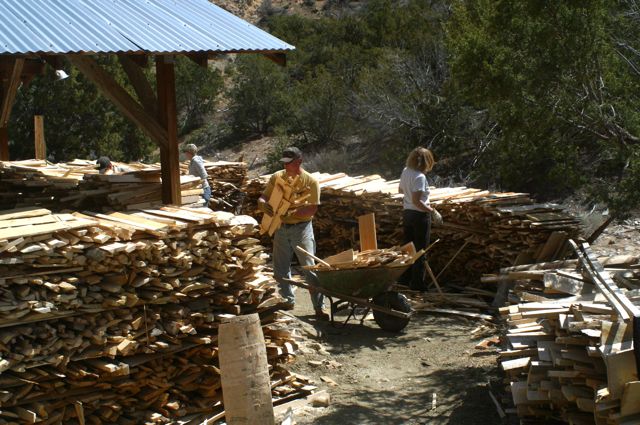
The larger pieces are stacked around the fire pit, not far from the front of the kiln (firebox). One firing will devour most of what you see here.

The pile’s getting smaller….
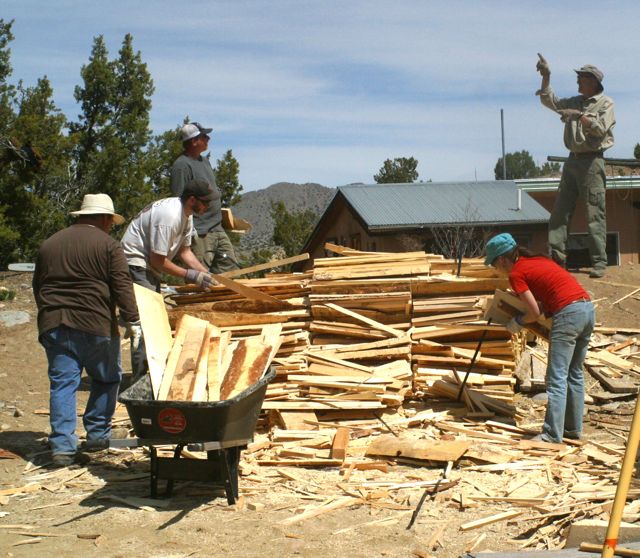
Bill: It's an owl carrying a cat!
Finally, the dregs are raked up and taken over to the Arroyo Of Many Broken Pots, where, as the name suggests, pieces that don’t survive the firings are often laid to rest.

UP NEXT: Day 2-4 Glazing wares and loading the kiln this weekend–stay tuned! You can also check out Jesse’s video journal here, for a live-action feel. (That’s me in the purple…
I’ve Got Mice Pre-quel
 Along with more traditional winter rituals such as decorating trees and eating too much, last year I found myself entrenched in a battle of sorts with the “seasonal inconvenience” that took up residence in my home, i.e., field mice. When I bought my 1922 “fixer-upper” nine years ago from an 80-year-old hoarder who never cleaned and certainly never threw anything away, it was obvious that rodents, and possibly wild birds, had long been a part of the interior landscape. Judging from the formidable droppings in the basement, I’d guess the array included raccoons, pack rats, and/or skunks. By the time I finished renovating, the mice were gone… until last year. (Perhaps it was a mistake to hang a bird feeder so close to the porch.) The once-outdoor mice spent all summer feasting and when it got cold, simply made for milder climes, namely my house.
In accordance with my spiritual beliefs and general philosophy, I prefer to respect rather than destroy life. For example, I have an agreement with all spiders: “You leave me alone, I leave you alone,” and often relocate rather than smash them. (It should be noted that, along with being limited to spiders and not roaches, this agreement is not so much due to heroic altruism as self-interest, as I know I’m vastly outnumbered.) This is not to suggest that I condone or enjoy living with mice; on the contrary, the filthy little creatures can be very destructive. And loud. But if you look at them, really look… they’re awfully cute and not so different from those sold as pets. They can’t help that they are filthy little creatures.
I just wanted to find a way for me to live and them to live. Apart. Thus, rather than taking the quick & convenient dCon route — I’d tried that once but the resulting foul, inaccessible odor emanating from under the fridge ruled it out — I committed to the “humane elimination” journey. Live traps. Homemade traps. Relocation. A journey that continues to this day, as the last four babies I caught a few weeks ago are coming of age in a bin in my living room. When it’s warm enough, I’ll relocate them to a certain chicken coop, where they will have access to food and shelter not near someone’s home, and they can fend for themselves against roadrunners and excitable hens. I’ll keep the location of this coop a secret in case, by some unlikely coincidence, one of my vast readership recognizes it as his neighbor’s.
Regarding the cup pictured here: Sometime in December, after I’d successfully rid my house of approximately 17 mice that were granted a second chance at life elsewhere, I threw a bunch of cups on my potter’s wheel, then covered them with plastic as they dried. The next day, I came back to trim the bottoms and found this. At first, I thought I’d accidentally dinged it, but on closer examination I realized that this was not a human act. The teenytiny bite marks and tooth impressions on the inside gave it away: a mouse. Although there had never been evidence of mice in the studio (a separate building next to the house), somehow, one of them had come in, crawled up the 4′ table, under the plastic, carefully chewed this half-circle, and left. Not so much as a turd marked its visitation.
I left the cup just as I’d found it, glazed the inside and fired it. Because I could never “make” something like this again, I decided it was perhaps the most valuable thing in my studio. I gave to the mice, they gave to me.
I’ve Got Mice
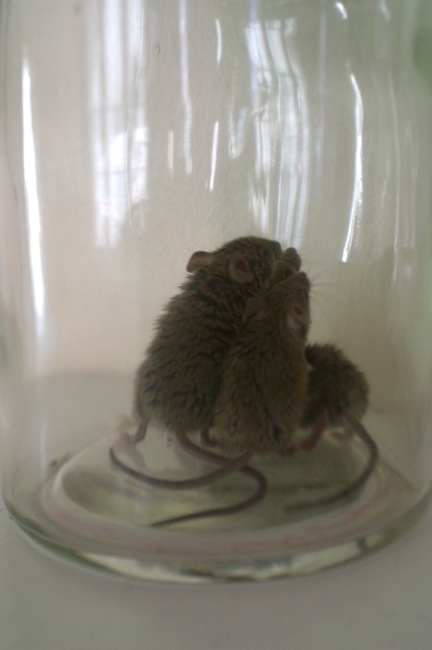
Fortunately, they are no longer running around my house but contained in various repositories. It’s been a long journey, one of infestation, love, love-hate, birth and death, compassion, inadvertent electrocution, regret. The story is filled with all the classic dramatic conventions, probably too long and too disturbing for just one blog post. So look for many. As the story inhabits both the past and present, I’ll run the narratives concurrently, just like Lost, full of mystery and intrigue but without the creepy black smoke and resurrected dead (let’s hope).
Pictured here are babies that were caught 10 days ago. It’s amazing how cute they are once they’re not in your cabinets.
Click to see my new website for ceramic & biodegradable cremation urns


 Live Clay